Future PICs are non-linear
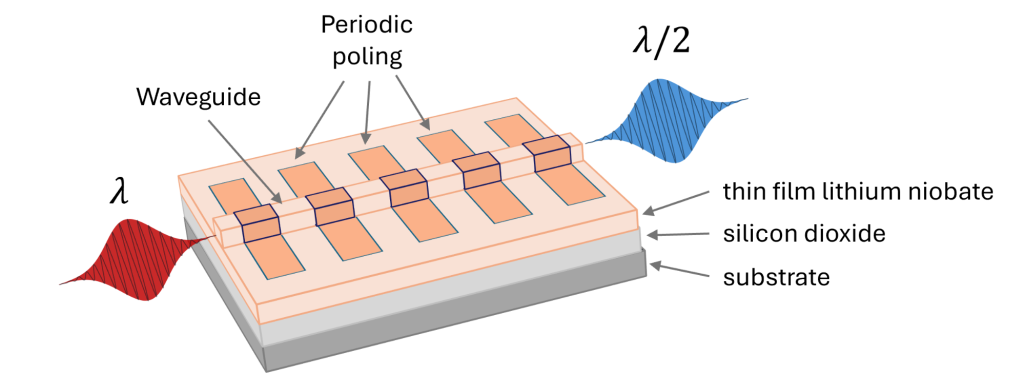
Nonlinear optics lets strong light fields control or create other light, enabling functions like wavelength conversion, harmonic generation, frequency mixing, and quantum light generation for applications in telecom, sensing, quantum technologies, precision measurement, and advanced lasers. This platform uses thin-film lithium niobate waveguides with high-quality periodic poling to achieve efficient, stable, and scalable chip-scale nonlinear devices, backed by extensive expertise spanning design, fabrication, characterization, and application-driven development.
Physical approach
Nonlinear optics describe the regime in which a material’s response depends on the strength of the optical field, enabling one optical signal to modify or generate another. In practice, this makes it possible to convert light from one wavelength to another, generate harmonics, mix frequencies, and generate and modify quantum light —capabilities that are central to applications in telecommunications, precision measurement, sensing, quantum photonics and communication, and advanced laser systems. Our platform is based on thin-film lithium niobate, a material combining outstanding second-order nonlinearity and electro-optic performance with the advantages of integrated photonics. By using small waveguides, light is confined to extremely small dimensions, increasing optical intensity and enabling strong nonlinear interactions in compact chip-scale devices. When combined with high-quality periodic poling for precise quasi-phase matching, this approach enables highly efficient and scalable nonlinear optical components with excellent stability and reproducibility.
Our technology is built on several years of research experience in bulk and thin-film lithium niobate photonics, nonlinear waveguide design, and quasi-phase-matched device engineering. Across these efforts, we have gained practical experience in the full chain from concept and simulation to fabrication, characterization, and application-oriented device development. This background is especially important in thin-film lithium niobate, where high device performance depends not only on the intrinsic material properties but also on precise control of nanofabrication and device design, which form key ingredients for moving nonlinear optical technologies from the laboratory into robust real-world systems.
Selected publications:
- Physical Review Letters 124, 163603 (2020). https://doi.org/10.1103/PhysRevLett.124.163603
- Optics Express 28, 19669 (2020). https://doi.org/10.1364/OE.395545
- Journal of Applied Physics 127, 193104 (2020). https://doi.org/10.1063/1.5143266
- Nanophotonics 14, 4761 (2025). https://doi.org/10.1515/nanoph-2025-0461
- Optics Express 33, 52729 (2025). https://doi.org/10.1364/OE.571605
> 10
years of scientific research
440
citations
Broad
network in science